The Insurance Industry is entering one of its most important transitions yet. Not because risk is increasing -risk has always existed. But because the nature of risk is changing.
Insurance was built for a world of static realities: fixed assets, predictable ownership, linear customer journeys, clearly defined liabilities. But, today's world operates very differently.
A customer can buy a car online, subscribe to mobility instead of owning it, work across multiple platforms, store their identity digitally, and increasingly rely on AI systems for decisions -all within the same ecosystem.
Risk no longer sits in one place.
It moves.
Across platforms. Across devices. Across ecosystems. Across identities. Across algorithms.
And perhaps that is the biggest shift of all.
We are entering what can only be described as the era of "Flow-Risk" -where exposure is no longer tied to a single product, but continuously flows across interconnected digital and physical experiences.
Which means the future of insurance may no longer be shaped by standalone products alone.
It may instead be shaped by the principles through which protection itself is designed.
So, this one is for the Leaders, Product Teams, Decision Makers & Transformation Thinkers trying to understand where insurance products are actually heading.
The focus here is not to predict the next flashy insurance product. Because products will continue to evolve.
The real focus is on understanding the deeper shifts quietly redesigning the insurance landscape itself.
Without much introduction - let us get straight into the shifts.
THE SHIFTS RESHAPING INSURANCE
1. The Distribution Shift- Insurance is moving from a destination to a layer.
Traditionally, customers had to actively seek insurance. Tomorrow, protection will increasingly appear inside journeys instead of outside them. The future of distribution may belong less to standalone selling and more to ecosystem integration.
2. The Product Design Shift- Insurance is moving from fixed products to adaptive protection structures.
Rigid, one-size-fits-all products are increasingly struggling to keep pace with changing lifestyles, technologies, and business models. Coverage is becoming more modular, configurable, and lifecycle-aware.
3. The Pricing & Risk Shift- Insurance is moving from static assumptions to real-time risk intelligence.
Connected ecosystems continuously generate signals: telematics, usage behavior, digital activity, operational patterns, and AI-generated decision trails. Risk assessment is becoming dynamic, continuous, and contextual.
4.The Prevention Shift- Insurance is moving from reimbursement to active risk prevention.
Insurers are no longer expected only to compensate for loss. Increasingly, they are expected to help reduce, predict, monitor, and even prevent the loss itself.
5. The Ecosystem Shift- Insurance is moving from isolated coverage to interconnected protection.
Modern risks rarely exist in silos. Platforms, marketplaces, mobility ecosystems, AI systems, and digital networks create shared and interconnected liabilities across multiple participants.
6. The New Risk Category Shift- Insurance is moving beyond physical assets into digital and algorithmic risk.
The next generation of exposure may increasingly come from: AI systems, digital identities, cyber ecosystems, platform dependencies, and data-driven operations. These are risks traditional insurance architectures were never originally designed for.
Here are the new products that the market is seeing as a result of these shifts -
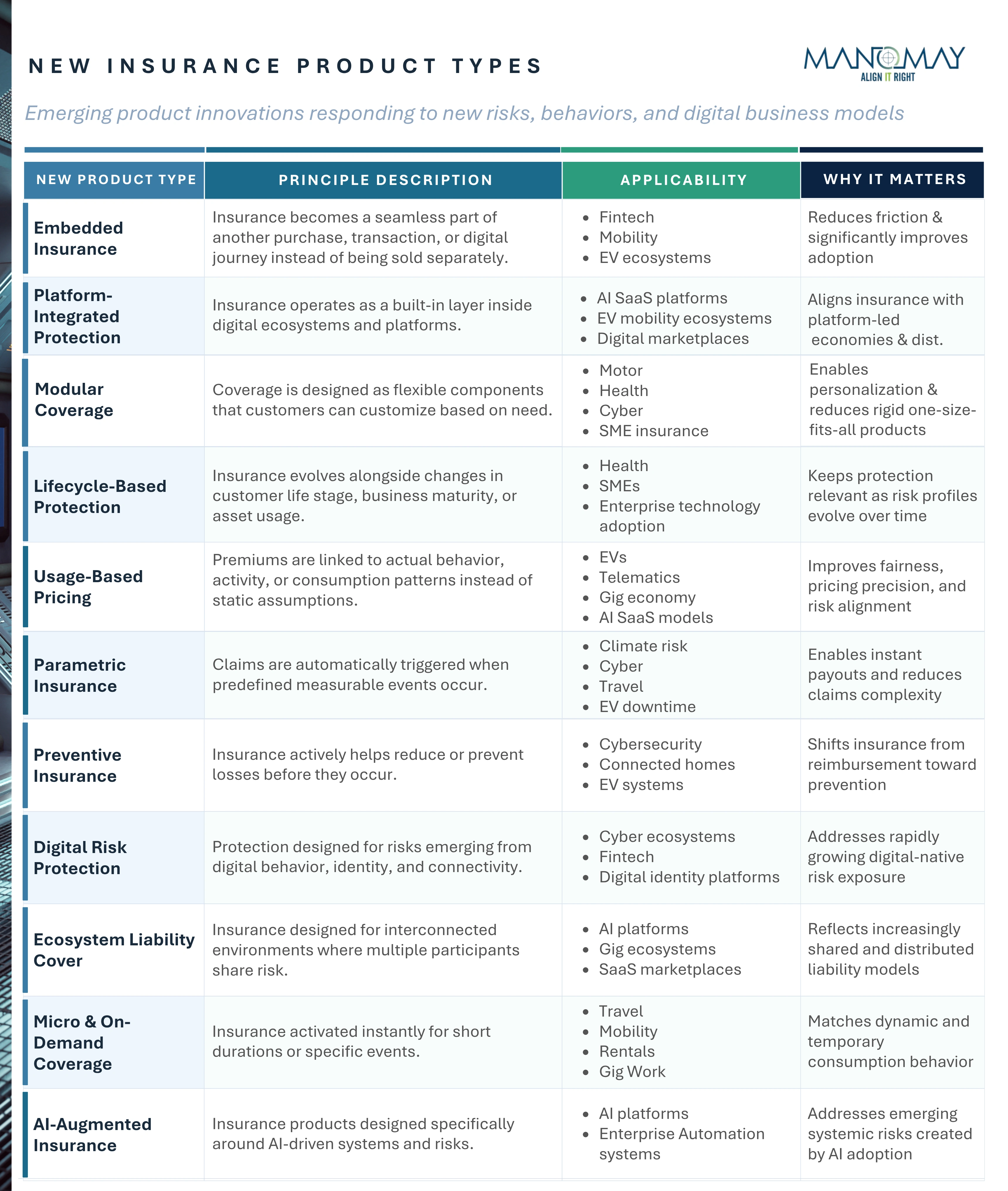
What makes these shifts important is that they are not isolated innovations.They are interconnected principles. The same embedded logic influencing travel insurance is now reshaping EV ecosystems and fintech journeys. The same preventive thinking driving wearable-based health insurance is beginning to influence cyber monitoring and connected mobility. The same usage-based models that transformed telematics are beginning to influence AI systems, digital ecosystems, and platform liabilities.
And slowly, almost quietly, insurance is transforming:
From a product industry to a protection architecture industry. That changes everything. Because the future of insurance may no longer be defined only by what is insured, or who is insured.
But increasingly by:
- where protection appears,
- how dynamically it adapts,
- how intelligently it senses risk,
- and how deeply it integrates into ecosystems.
And perhaps that is the real shift underway. Not just new insurance products. But an entirely new philosophy for designing protection itself.
Explore our full suite of services - Here