
In a world where AI is rapidly becoming central to QA and test automation, there's an uncomfortable truth emerging - adoption isn't translating into outcomes.
Nearly 73% of test automation initiatives fail to deliver expected ROI.
Which raises a deeper question: If teams have more tools, more automation, and now AI - why are results still falling short?
Because the problem was never just execution. It was always about what we choose to test, when we test it, and how deeply we understand the business behind it.
AI can accelerate QA - but it cannot correct a weak foundation. Whether it's automation or AI, without the right strategy, data, and domain context, they simply accelerate failure rather than success.
As insurers move from legacy systems to cloud-native, API-first ecosystems, Quality Assurance has evolved into a mission-critical function - not just for stability, but for strategic growth.
Insurance runs on data, timing, and trust; a single defect in a quote engine, claims payout, or compliance check can trigger financial and reputational risk.
QA ensures that innovation doesn't come at the cost of accuracy - safeguarding every customer interaction, every algorithmic decision, and every promise made in real-time right from instant quotes to AI-led claims processing.
When deadlines are tight and business goals ride on tech execution, leaders aren't just looking for speed - they want assurance that what's delivered works, scales, and adds value:
- Will the system behave as expected?
- Will it scale across geographies and product lines?
- Will one missed dependency surface too late - costing you time, money, and trust?
That's where QA comes in - not as a final checkpoint, but as your first line of defense against transformation risk.
We've seen this play out across dozens of insurance journeys. Rushed implementations. Siloed testing. Unexpected production failures that are traced back to logic gaps no one thought to check. Over time, we've learned that in insurance, QA isn't just about validation, it's about assurance. And assurance demands more than tools or automation. It demands domain depth, early intervention, and a mindset that sees QA as a strategic enabler.
This article is about exactly that.
It aims to provide a clear understanding of the key elements that drive success in AI-powered Quality Assurance.
More importantly, it reframes QA - from a reactive function to a proactive, continuous, and business-critical capability. It also helps you assess where your QA stands today, and what it takes to make it stronger, smarter, and better aligned with your transformation goals.
Let's get into it.
Not all QA practices are created equal. Your outcomes are largely determined by your maturity level, which directly impacts the effectiveness of your transformation efforts. To give you a clearer sense of where you might stand, here's a quick view of how we see QA maturity in the insurance world:
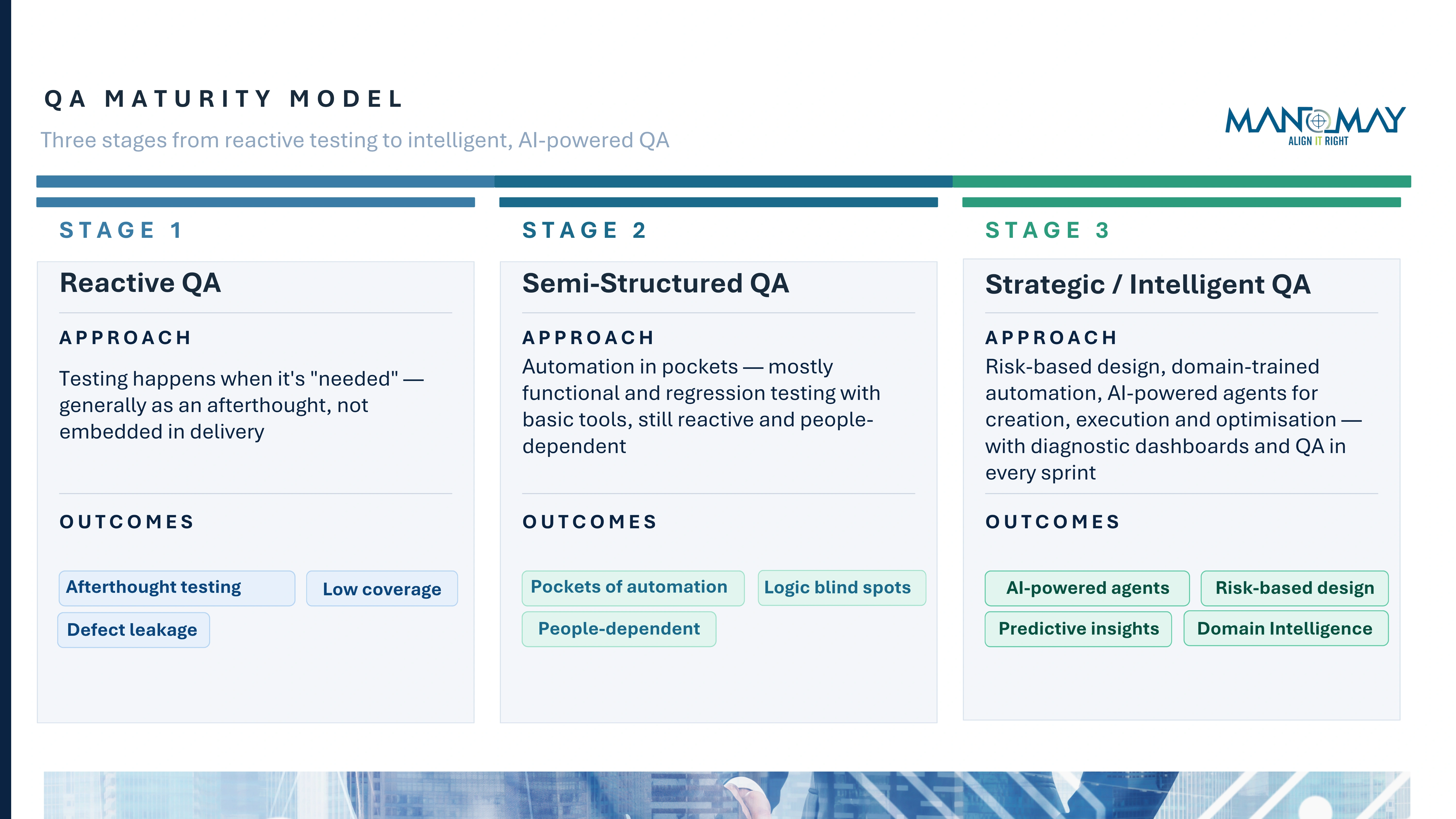
Now here's the thing - not every company wants or needs to hit level 3 right away. But knowing where you are helps you focus. And that, in turn, helps you grow. What's needed is the maturity of understanding the QA insurance logic and how early it can intervene in the transformation lifecycle.
It ultimately depends on what your priorities are - and who your partners are. And that's why, in our work with insurers across geographies, some recurring questions come up - especially from CIOs, CTOs, and Heads of Transformation:
- "How do we know our QA coverage isn't missing blind spots?"
- "Can our QA approach handle product diversification or geographic scaling?"
- "What's the actual cost of poor-quality post go-live?"
- "How secure is it to give you, our data?"
- "Why are we always discovering issues post go-live?"
- "Where, when, and why should we leverage AI - and how do we ensure it's applied to the right use cases?"
Notice something? Most of these aren't about tools or scripts.
They're about visibility, reliability, and strategic alignment. And they're valid. So, your focus with QA today needs to be around building it as a navigator- Now, this is where we get to the core of what you can do to help go to your future state and how our experience might help set the direction.
The Manomay QA Weightage Plan: From Preparation to Continuous Quality-Bridging
At Manomay, we combine three essential elements: Right Strategy, Right Domain Expertise, Right Technology, to craft a QA weightage model that bridges critical blind spots and to address these deep-rooted challenges leadership team and project stakeholders face in delivering consistent, high-quality products
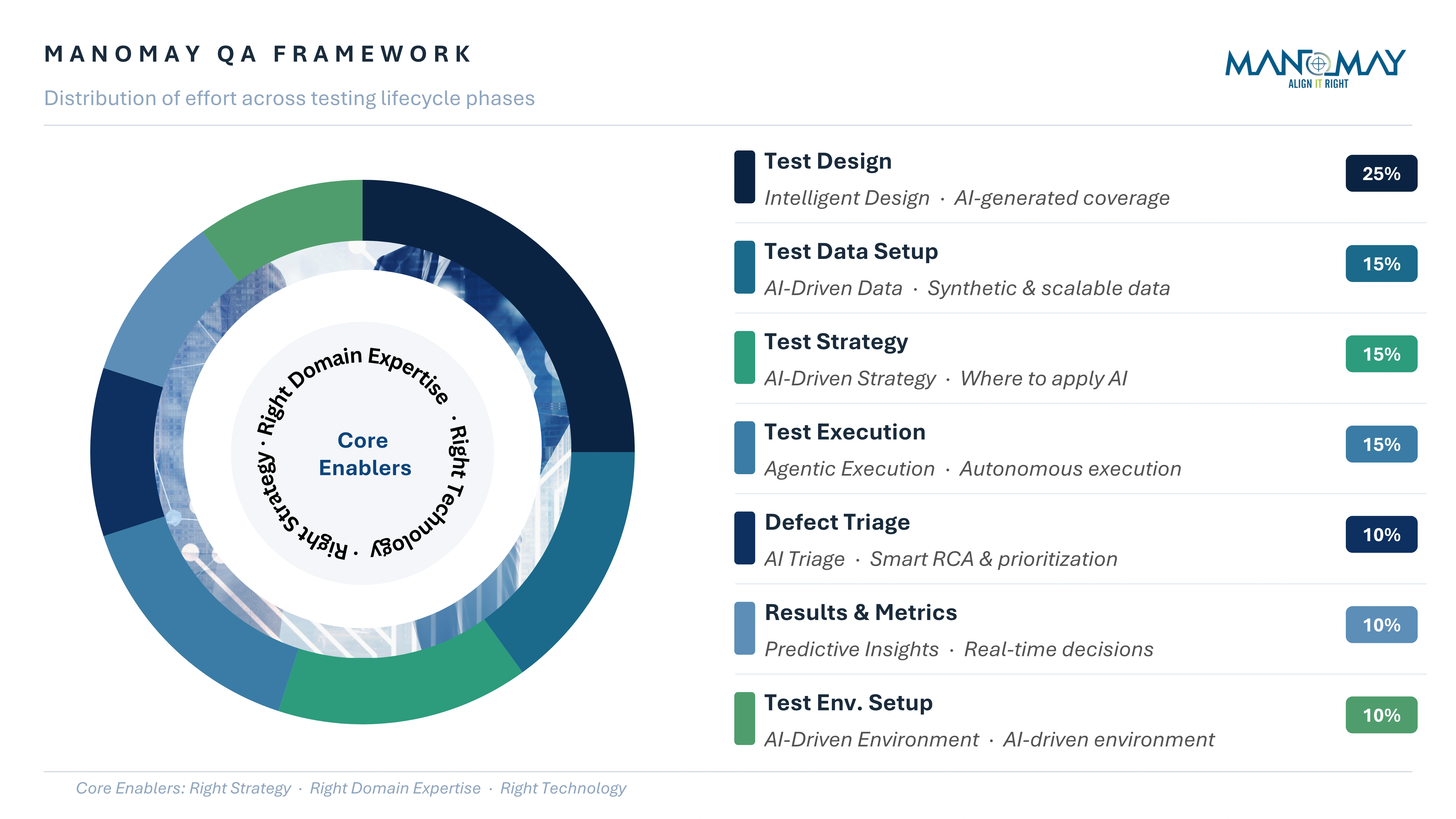
Behind this AI-driven QA weightage model lies a set of foundational enablers that make scalability both practical and sustainable. At its core, the model is built on:
- Deep domain expertise, combined with in-depth analysis of business workflows, patterns, and realistic data usage across the insurance lifecycle - ensuring that quality is engineered with true business context.
- A robust test library for core insurance functions, spanning Lines of Business such as P&C, Life, and Pensions - enabling reuse, consistency, and comprehensive coverage across products.
- Accelerators in the form of quick-start templates, covering processes, test data, and customizable execution dashboards - driving speed, standardization, and adaptability.
With these foundations in place, AI and automation are applied purposefully - where they create the most value - aligned to specific customer needs and platform landscapes.
In insurance, defects don't start in execution - they start in missed logic, poor data, and weak design. Yet most QA models over-invest in execution and under-invest in prevention.
The Manomay QA Weightage Plan corrects this imbalance:
- Shift from Detection to Prevention [Test Strategy 15% & Test Design 25%] - Is where decisions on where AI should be applied, what not to test, risk prioritization as part of strategy & logic validation, edge cases, and coverage expansion to happen at design stage
- Data becomes first class citizen [Test Data Setup 15%] - Eliminates one of the biggest root causes of production defects
- Execution becomes lean & intelligent [Test Execution 15%, Defect Triage 10% & Metrics - 10%] is where predictive insights, root cause clustering and real time dashboards contributes the feedback loop move earlier into the lifecycle
Why this matters: Most QA failures aren't due to lack of effort, but misplaced effort - too much execution leads to late defect discovery, weak design misses critical scenarios, poor data creates false confidence, and limited triage causes recurring issues.
Our model addresses these blind spots by front-loading intelligence and distributing accountability across the lifecycle - ensuring quality is built upstream, not just tested downstream.
Backed by domain-led accelerators and AI-driven capabilities, QA evolves from a checkpoint to a continuous risk control system - enabling confident, high-quality releases.
Because in insurance, assurance - not just testing - is what protects growth.
Ultimately, CXOs want clarity: Where are we today, and how can we get better? The answers lie not just in the tools or technology you use, but in the mindset, deep domain expertise and processes you adopt along the way.
So, What Now?
QA is no longer just a validation function - it is a critical business enabler.
Especially in insurance - where regulatory pressure, complex products, and customer trust all come together - your QA can quietly determine your success.
If you've been firefighting post go-live, relying on people-heavy testing, or struggling with poor visibility - maybe it's time to pause and rethink. Not just your tools, but your QA philosophy.
Seek not perfect QA - but purposeful QA.