
"AI Agents". "Autonomous workflows". "Intelligent operations". These phrases are appearing everywhere in boardroom discussions around the future of enterprise technology.
But the real question insurers are asking is far simpler.
Are these technologies truly changing the way insurance operations function? Or are they simply another wave of automation tools promising incremental efficiency?
And more importantly -
What do they mean for the way insurers manage their operational backbone today?
For decades, the key insurance functions have relied on a combination of people, processes, and platforms working in carefully designed sequences.
Now a new capability is emerging - agentic systems - that has the potential to change not just how tasks are executed, but how operational decisions are made.
Over the last decade, insurers have invested significantly in operational modernization. We have seen AI assisting underwriting and claims evaluation, Digital portals simplifying customer interactions, Analytics platforms improving risk insights and more. Research from McKinsey & Company indicates that such transformations can even result in:
- 20-40% reduction in operational processing effort
- 15-30% improvement in cycle times for core insurance journeys
- Up to ~30% increase in process accuracy in areas such as claims and underwriting workflows
But in most programs, despite automation, operations remain heavily dependent on human coordination.
Exceptions still require manual intervention, processes still depend on multiple system handoffs and decision-making still sits largely with individuals rather than intelligent systems.
Automation has optimized execution. But operations are still waiting to evolve in intelligence.
That's where Agentic systems come in! Unlike traditional automation, these systems introduce a new capability layer into enterprise operations because they can- interpret context, coordinate across multiple systems, reason through process steps and much more.
Instead of simply executing predefined workflows, AI agents can manage operational journeys.
In insurance, this could mean:
- Claims agents that assess documentation and route cases intelligently.
- Underwriting assistants that analyze submissions and highlight anomalies.
- Policy servicing agents that coordinate multiple systems to fulfill customer requests.
- Compliance agents continuously monitoring operational adherence.
- ...
The shift is subtle but powerful.
Automation performs tasks. Agentic systems orchestrate work.
But Where Should Insurers Begin?
This is the same question we have heard repeatedly when new technologies emerge- "Where do we start? What do we do with our existing systems? Do we rebuild everything? Will these technologies replace operational teams?"
And here begins the real story.
For most insurers, transformation does not happen through radical reinvention.
It happens through structured evolution.
Which brings us to an important strategic choice.
Two Paths to Operational Transformation
Insurers exploring agentic operations typically face two approaches.
1. Total Transformation- This involves designing entirely new operational models built around AI-native processes. Examples may include fully digital insurers, embedded insurance ecosystems, on-demand policy architectures, etc.
These models are powerful, but they are often easier to implement in new ventures or greenfield environments.
2. Incremental Transformation- For most established insurers, transformation follows a different path with complex elements at play like your legacy systems, established operating model, regulatory constraints, and large operational workforces. These realities require a more pragmatic approach.
Incremental transformation focuses on embedding intelligence into existing operations, step by step.
Our observation across the market is clear: The majority of insurers prefer the incremental path.
Not because they lack ambition, but because sustainable transformation must be absorbed by the organization.
So here's a sneak peek into how we approach our Agentic Operations transformation-
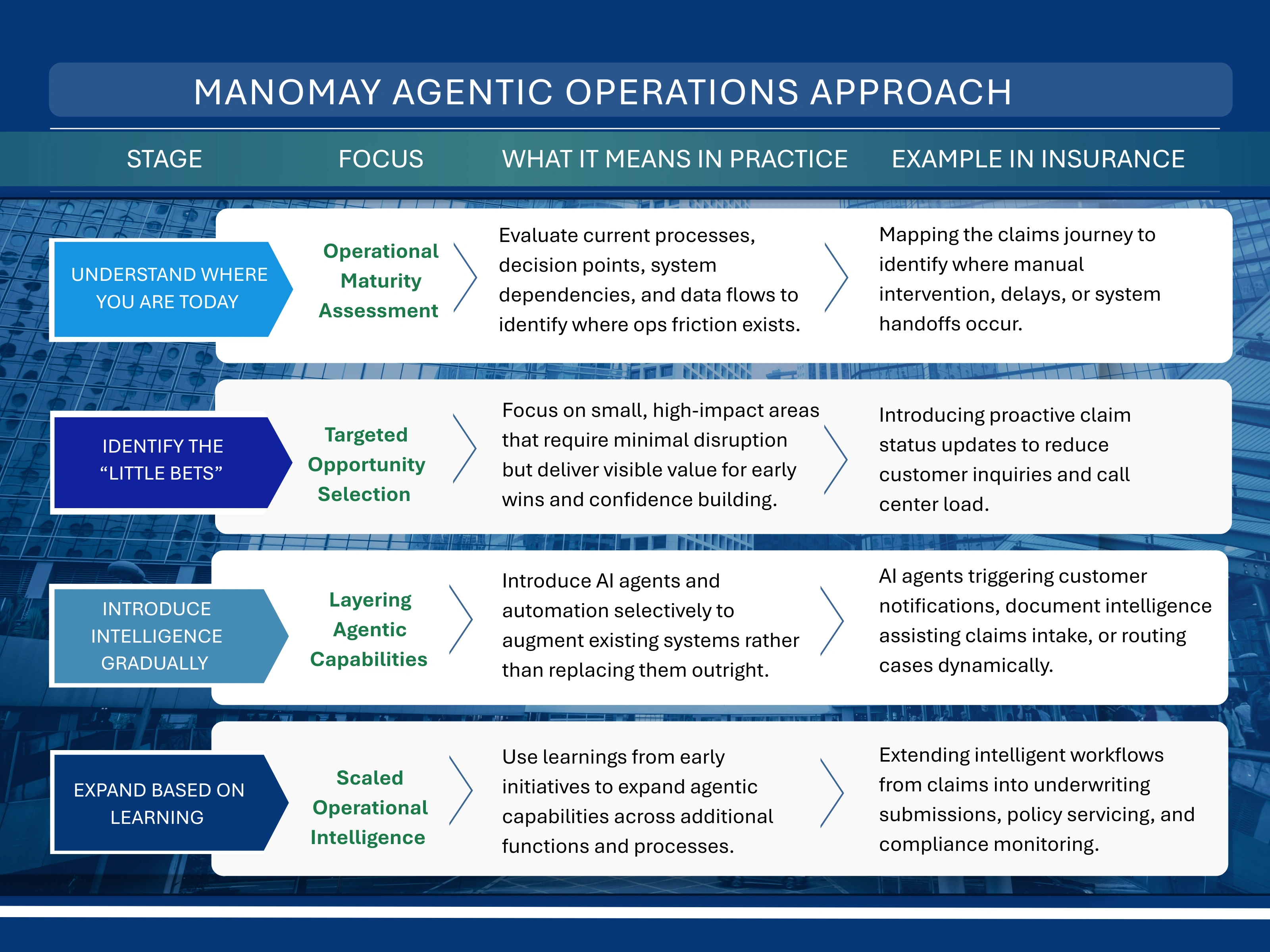
The most effective transformations in insurance have rarely come from sudden reinvention. They have come from steady, deliberate steps that compound over time.
Agentic operations will be no different.
It is not a shift that replaces everything that exists today. It is a shift that quietly changes how existing systems think, respond, and coordinate. One process at a time. One decision layer at a time.
And in that evolution, the role of technology is not to take over operations - but to make them more aware, more responsive, and more connected than ever before.
Because in the end, the real measure of progress will not be how automated insurance becomes. It will be how intelligently it operates.
Want to start your journey toward agentic operations? Talk to us at biztechinsights@manomay.biz
Explore our full suite of services - Here